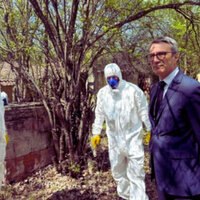


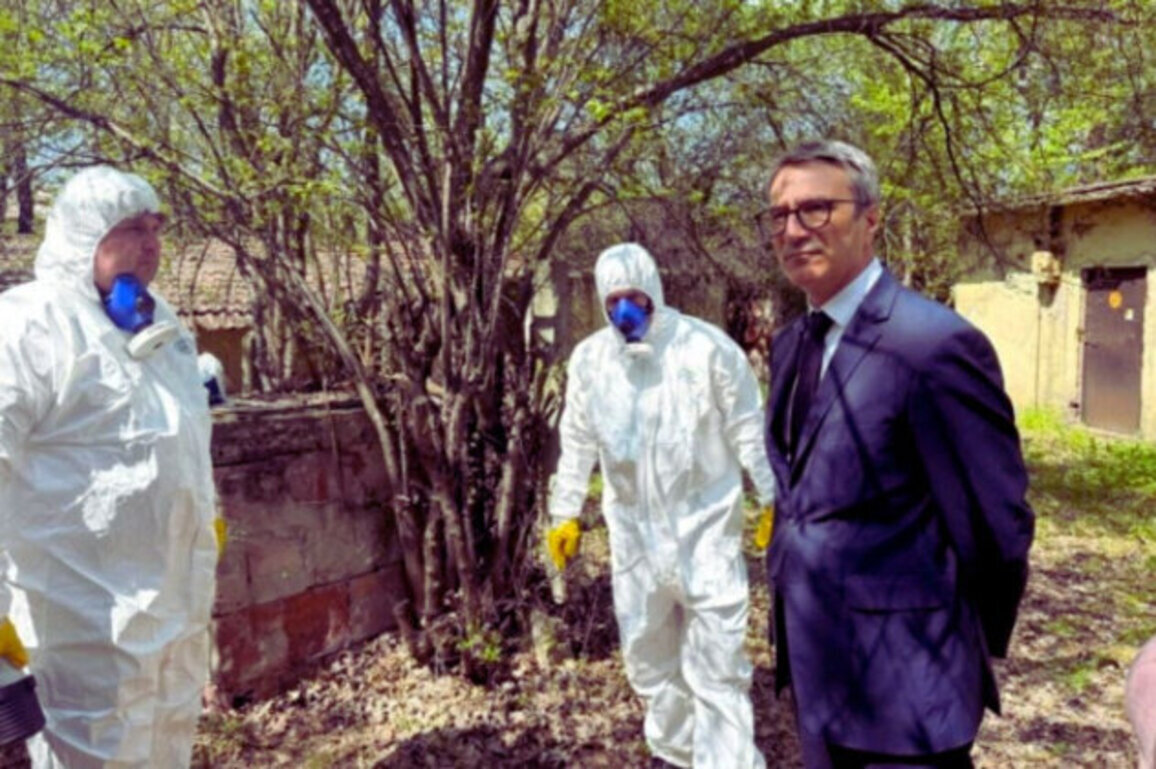
An urgent inspection was ordered in Sofia's Malinova Dolina district after reports of possible radiation contamination at the former site of the Central Isotope Repository. Acting Energy Minister Traycho Traykov personally attended the inspection following a signal alleging radioactive pollution in the area.
Specialized teams from the State Enterprise ?Radioactive Waste? carried out a full on-site survey using field devices designed for isotope identification. The results were presented to Minister Traykov, Deputy Minister Krasimir Nenov, the Director of the National Center for Radiobiology and Radiation Protection Prof. Dr. Zhana Dzunova, and other responsible officials.
According to the minister, measurements showed elevated radiation levels in certain specific points. ?In some points, values between 10 and 70 times above the natural background were recorded,? Traykov said. He clarified, however, that these readings were registered at a height of around 10 centimeters above ground level and, under the current access restrictions, do not pose a danger to people or the environment.
Traykov urged residents not to cross the fenced-off areas and stressed that the state must finally resolve the issue. ?This case has been dragging on for decades. It is unacceptable for such a problem to remain unresolved in a residential district of Sofia,? he stated.
He also announced that he had tasked the State Agency for Waste Management with preparing a full report, including an estimate of the funds needed for remediation. ?The report will be submitted for consideration to the Council of Ministers,? the minister added.
The closed base of the former Central Isotope Repository is located on land that is public state property but currently belongs to the Bulgarian Red Cross. The buildings and facilities on the site are managed by the National Center for Radiobiology and Radiation Protection under the Ministry of Health.
Under the Law on the Safe Use of Nuclear Energy, the cleanup of terrain contaminated with radioactive substances is carried out under a permit regime. Responsibility for restoring such sites and covering the costs falls on those whose activities originally generated the radioactive waste.
The Ministry of Health also issued a statement emphasizing that it has participated for years in monitoring and surveying the terrain. According to the ministry, long-term systematic radiation control, including checks by its specialized structures, shows no deviations from normal radiation levels outside the fenced zone.
Officials said no spread of radioactive substances into the surrounding air or water has been detected. ?Outside the fenced area no deviations from the natural radiation background have been detected,? the ministry stated, adding that there is currently no threat to public health as long as access restrictions remain in place.
Inside the restricted zone itself, however, localized areas containing residual radioactive substances have been known for decades. Expert assessments, including recommendations from missions of the International Atomic Energy Agency, have concluded that a permanent solution requires full remediation through the removal of contaminated soil and materials.
The Health Ministry stressed that there is currently no evidence of danger to residents outside the restricted perimeter but called on citizens to strictly respect the barriers and warning zones. According to the institution, only coordinated institutional action, transparent information, and full decontamination of the affected terrain can bring a final solution to a problem that has remained unresolved for years.