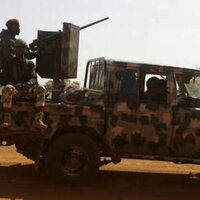


Expanding terrorist networks, mass displacement and the collapse of essential services in West Africa and the Sahel are a growing concern worldwide.
The UN Secretary-General called on Wednesday for action to prioritize Africa, urging the world not to turn its back on the continent.
The world is facing a cross-border chain of violence driven by small arms and light weapons, UN disarmament and law enforcement officials told the Security Council on Monday.
Thats according to theUN Secretary-GeneralAntnio Guterreswho toldtheSecurity Councilon Monday that the growth in terrorist groups was not only a regional dramatic reality.
Progressive links of its groups in Africa and beyond make it a growing global threat.
The vast Sahel region which stretches almost coast to coast across Africa,accounts for 19 per cent of terrorist attacks worldwideand for over half of global terrorism-related casualties.
Around four million people are now displaced across Burkina Faso, Mali, Niger and neighbouring countries.
Responding to the threat
To address the crisis, Mr. Guterres urged aunified, coherent and consensus-based regional response, the maintenance of financial support for humanitarian response plans and a development strategy to address the root causes of terrorism.
Along those lines, he encouraged intelligence sharing and financial tracking through theUN Global Counter-Terrorism Compact, the UNs coordination mechanism against terror, and the Economic Community of West African States (ECOWAS) counter-terrorism strategy.
He further noted that humanitarian appeals for the Sahel and Lake Chad Basin remain severely underfundedless than one quarter of the $4.9 billion required has been raised.
Terrorists thrive where the social contract is broken, he added, highlighting the need to fight poverty and invest in sustainable development.
Collaboration and synergy
Omar Alieu Touray, President of the ECOWAS Commission, warned that terrorism has spread beyond the Sahel and Lake Chad Basin to threaten all of West Africa.
He informed the Security Council that ECOWAS is accelerating deployment of its standby force, starting with 1,650 personnel and scaling up to 5,000 with regional and partner support.
He said that while partners have taken action to combat terrorism, the proliferation of these initiatives has led to fragmentation, hindering cooperation. He stressed that coordination and cohesion must be a priority.
No amount of money, no amount of equipment will help us overcome terror if we dont collaborate and build synergy, Mr. Touray said.
Our current differences should not be exploited; they should be bridged, he added.
Moral compass
We must re-imagine ECOWAS not just as a regional bloc, but as a community of courage, the moral compass and stabilising force of Africa, said Julius Maada Bio, president of Sierra Leone which also holds the Security Council presidency for November and chair of ECOWAS.
He went on to push for democratic trust, decisive action in the fight against extremism and regional security and coordination.
On those grounds, he proposed an ECOWAS-UN-African Union compact a coordinated mechanism to ensure predictable financing and operations across the region.